
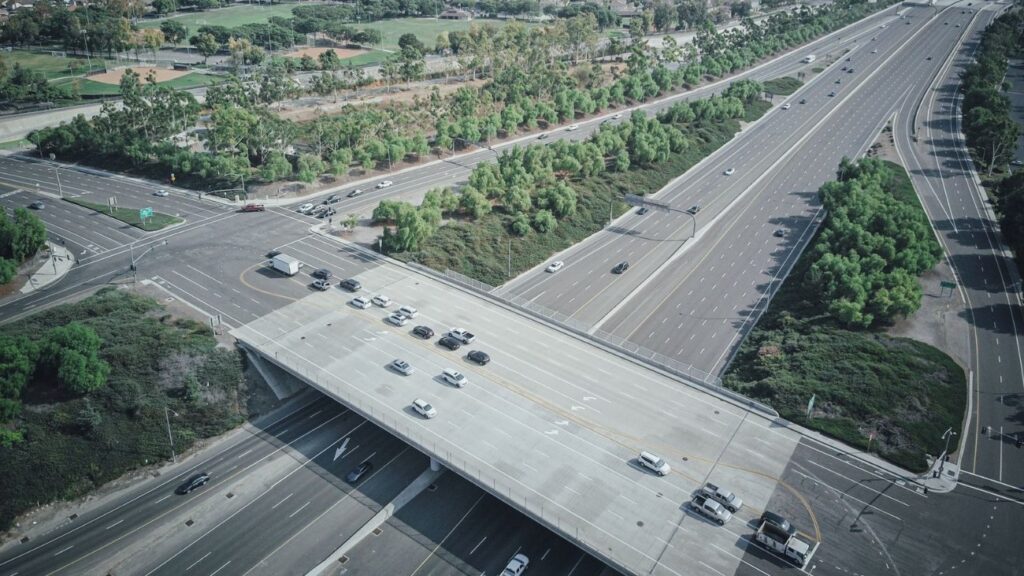
Highway 407 ETR is the fastest way across the top of Toronto, and the hardest road in Ontario to price. The rate changes by zone, by direction, by day and by the minute you get on. And on January 1, 2027, every one of those rates goes up.
This 407 toll calculator does the maths for you. Pick where you get on and off, the day and the time, and it shows the toll zone by zone, with the 2026 rates you pay today and the new 2027 rates side by side. It also shows what the same trip costs without a transponder, which is where most surprise bills come from.
Checked on November 28, 2026 against 407 ETR’s published 2027 rates and fees for light vehicles and its 2026 rate chart. Distances between interchanges are approximate, so treat the result as a close estimate and not a bill.
407 Toll Calculator
For cars, SUVs, vans and small pickups on 407 ETR, from the QEW in Burlington to Brock Road in Pickering.
An estimate from 407 ETR’s published per-kilometre rates and approximate interchange distances. Your bill can differ by a few cents per zone. Not affiliated with 407 ETR.
How the 407 toll calculator works out your trip
Three things set the price of a trip on 407 ETR: how far you drive, which of the 12 zones you pass through, and the time you enter the highway. 407 ETR prices the whole trip by your entry time, so when you exit doesn’t change the rate. Each zone has its own per-kilometre rate for eastbound and westbound traffic, with separate tables for weekdays and for weekends and Ontario stat holidays.
On top of the distance toll, every trip carries a $1 trip toll charge. If you don’t have a transponder, a camera reads your plate and adds a camera charge: $5.30 per trip in 2026 and $5.40 in 2027. Weekend rates also apply on stat holidays, so it’s worth knowing which days count as Ontario stat holidays in 2027.
| Zone | Stretch | Approx. length |
|---|---|---|
| Zone 1 | QEW to Dundas St | 6.0 km |
| Zone 2 | Dundas St to Neyagawa Blvd | 12.9 km |
| Zone 3 | Neyagawa Blvd to Hwy 403 | 5.9 km |
| Zone 4 | Hwy 403 to Hwy 401 | 10.0 km |
| Zone 5 | Hwy 401 to Hwy 410 | 12.5 km |
| Zone 6 | Hwy 410 to Hwy 427 | 11.6 km |
| Zone 7 | Hwy 427 to Hwy 400 | 8.2 km |
| Zone 8 | Hwy 400 to Yonge St | 11.3 km |
| Zone 9 | Yonge St to Hwy 404 | 5.0 km |
| Zone 10 | Hwy 404 to McCowan Rd | 7.1 km |
| Zone 11 | McCowan Rd to York-Durham Line | 8.9 km |
| Zone 12 | York-Durham Line to Brock Rd | 8.6 km |
407 toll rates for 2027: rush hour vs off-peak
These are the 2027 per-kilometre rates for light vehicles (cars, SUVs, vans and small pickups) at the two weekday peaks, plus the overnight rate. All figures are cents per kilometre and take effect on January 1, 2027.
| Zone | Eastbound 7 a.m. | Eastbound 3:30 p.m. | Westbound 7 a.m. | Westbound 3:30 p.m. | After 9 p.m. (eastbound) |
|---|---|---|---|---|---|
| Zone 1 | 72.34 | 72.33 | 116.86 | 119.77 | 54.93 |
| Zone 2 | 71.93 | 71.91 | 74.95 | 74.96 | 55.62 |
| Zone 3 | 71.93 | 71.92 | 77.60 | 77.62 | 55.62 |
| Zone 4 | 71.94 | 71.93 | 80.03 | 80.04 | 55.62 |
| Zone 5 | 79.73 | 79.72 | 98.16 | 99.63 | 55.62 |
| Zone 6 | 127.89 | 127.90 | 110.14 | 120.15 | 55.62 |
| Zone 7 | 135.34 | 143.05 | 130.54 | 130.56 | 55.62 |
| Zone 8 | 135.34 | 143.05 | 130.54 | 130.54 | 55.62 |
| Zone 9 | 135.34 | 143.05 | 130.54 | 130.54 | 55.62 |
| Zone 10 | 114.72 | 123.27 | 74.76 | 74.75 | 55.62 |
| Zone 11 | 114.72 | 140.28 | 119.08 | 77.84 | 55.62 |
| Zone 12 | 114.72 | 140.24 | 119.08 | 77.84 | 55.62 |
The most expensive stretch in 2027 is eastbound from Highway 427 to Highway 404 in the afternoon rush, at 143.05 cents per kilometre. The cheapest time on every zone is after 9 p.m., at roughly 55 to 56 cents. Weekday rate bands start at 5, 7, 9:30 and 10:30 a.m., then 12:30, 2:30, 3:30, 6 and 9 p.m. The 12:30 p.m. band is new for 2027.
What changes on January 1, 2027

407 ETR announced the 2027 schedule on November 20, 2026. It says per-kilometre increases range from five to about 24 cents, and that most customers with a transponder will see their monthly bill rise by an average of $3.28. Rush-hour regulars making up to 16 trips a month should expect closer to $11.68. The fees move too:
| Charge | 2026 | 2027 |
|---|---|---|
| Highest per-km rate (light vehicles) | 119.21 cents | 143.05 cents |
| Overnight per-km rate | about 50.6 cents | about 55.6 cents |
| Trip toll charge | $1 per trip | $1 per trip |
| Camera charge (no transponder) | $5.30 per trip | $5.40 per trip |
| Account fee (no transponder) | $5 a month | $5.10 a month |
| Transponder lease, yearly | $31.50 plus tax | $32.50 plus tax |
| Transponder lease, monthly | $5 plus tax | $5.10 plus tax |
| Flat toll, peak (trip not captured, no transponder) | up to $13.65 | up to $15.75 |
| Flat toll, off-peak | up to $9.25 | up to $10.60 |
Here is what that does to real trips. These are our estimates from the calculator above, with a transponder:
| Trip | 2026 | 2027 |
|---|---|---|
| Hwy 427 to Hwy 404, weekday 8 a.m. | $28.63 | $34.16 |
| Same trip at noon | $21.06 | $23.15 |
| Same trip at 10 p.m. | $13.39 | $14.63 |
| Same trip, Saturday 2 p.m. | $22.38 | $26.66 |
| QEW (Burlington) to Hwy 401, weekday 8 a.m. | $22.79 | $26.06 |
| Hwy 400 to Hwy 404, weekday 5 p.m. | $20.43 | $24.32 |
| Hwy 401 to Yonge St, weekday 5 p.m. | $45.28 | $53.70 |
| End to end, QEW to Brock Rd, weekday 5 p.m. | $100.77 | $119.20 |
No transponder, rental cars and visitors

You don’t need to stop or pay on the spot. Cameras read your plate and the bill goes to the registered owner. It costs more, though. In 2027 each camera-recorded trip adds $5.40, and there is a $5.10 account fee in any month you use the highway. That turns the $34.16 rush-hour trip above into $39.56 before the account fee.
407 ETR’s own maths is that a transponder pays for itself after three round trips. The 2027 lease is $32.50 a year plus tax, or $5.10 a month.
In a rental car, the bill goes to the rental company first, and most add their own admin fee before passing it on. Ask at the counter what they charge before you leave the lot. If a trip can’t be captured properly and there is no transponder, 407 ETR charges a flat toll instead: up to $15.75 at peak times and up to $10.60 off-peak in 2027, plus the camera charge.
Which parts of the 407 are free?
Only the part east of Brock Road. Ontario removed tolls from the provincially owned Highway 407 East, from Brock Road in Pickering to Highway 35/115 in Clarington, on June 1, 2025. Highways 412 and 418 are toll-free as well. Everything west of Brock Road, all 108 km to Burlington, is the privately run 407 ETR and is tolled around the clock. So a drive from Oshawa to Markham is free until Brock Road and tolled from there.
Is the 407 worth it over the 401?
It depends on the hour. 407 ETR’s figure is 20 to 60 minutes saved on a typical rush-hour trip. Against that, the rush-hour price for crossing the top of the city, Highway 427 to Highway 404, is about $34 one way in 2027. For a daily commuter that is roughly $68 a day.
Where it earns its money: getting to Pearson when the 401 is jammed, a Friday afternoon escape north, or a one-off trip where an hour matters. It’s also handy at the west end if you’re heading for Niagara Falls in winter or out to St. Jacobs for lunch, and for getting out of the city early on one of these winter getaways in Ontario.
7 ways to pay less on the 407
- Drive it late. After 9 p.m. every zone drops to about 55 or 56 cents per kilometre in 2027, less than half the rush-hour rate on the busy central zones.
- Mind the clock when you get on. The rate is set by your entry time. Getting on at 6:55 a.m. instead of 7:05 puts the whole trip on the cheaper early band.
- Get a transponder if you will make more than three round trips a year. It removes the camera charge and the monthly account fee.
- Use it only where the 401 is worst. Eastbound in the afternoon, Zones 7 to 9 (Highway 427 to Highway 404) cost almost twice as much per kilometre as Zones 1 to 4.
- Go early on weekends. Weekend rates step up at 10 a.m. and fall again at 7 p.m.
- Create a My Account to receive driving offers. 407 ETR says offers save participants more than $100 a month on average, and a points program called ETR Rewards is due in 2027.
- Check Route Relief. Eligible low-income individuals and families can get eight free trips a month through 407 ETR’s Route Relief program.
For an exact quote before you drive, compare the result with 407 ETR’s own trip calculator.
How much does the 407 cost per km in 2027?
For light vehicles, from about 55 cents per kilometre overnight to 143.05 cents eastbound between Highway 427 and Highway 404 in the weekday afternoon rush. Every trip also has a $1 trip toll charge.
How much does 30 km on the 407 cost?
In 2027, with a transponder, between about $17.70 late at night and roughly $43 in the afternoon rush on the busiest central zones. Without a transponder, add a $5.40 camera charge per trip.
How are 407 tolls calculated?
Distance in each zone multiplied by that zone’s per-kilometre rate, which depends on direction, the day and the time you enter the highway, plus a $1 trip toll charge. The time you exit does not change the rate.
What happens if I drive the 407 without a transponder?
Cameras record your licence plate and the bill goes to the registered owner. In 2027 you pay a $5.40 camera charge per trip and a $5.10 account fee in each month you use the highway, on top of the toll.
Is the 407 cheaper on weekends?
Mostly, yes. Weekend and stat holiday rates top out at 104.72 cents per kilometre in 2027, against 143.05 cents on weekdays, and fall to about 55 cents after 9 p.m.
Is the 407 East free?
Yes. The provincially owned Highway 407 East, from Brock Road in Pickering to Highway 35/115, has been toll-free since June 1, 2025, along with Highways 412 and 418. West of Brock Road is 407 ETR, which is tolled.
Is a 407 transponder worth it?
If you make more than three round trips a year, yes. The 2027 lease is $32.50 a year plus tax, and it removes the $5.40 camera charge per trip and the $5.10 monthly account fee.
Should You Take the 407?
Run your trip through the 407 toll calculator first. If the number looks fair for the time it saves, take it and don’t look back. If you’re on it more than a few times a year, get the transponder before anything else. And if it’s after 9 p.m., the toll is less than half the rush-hour price on the busy zones, so the answer is usually yes.
Pingback: Is Stouffville a Good Place to Live in 2026? Honest Guide