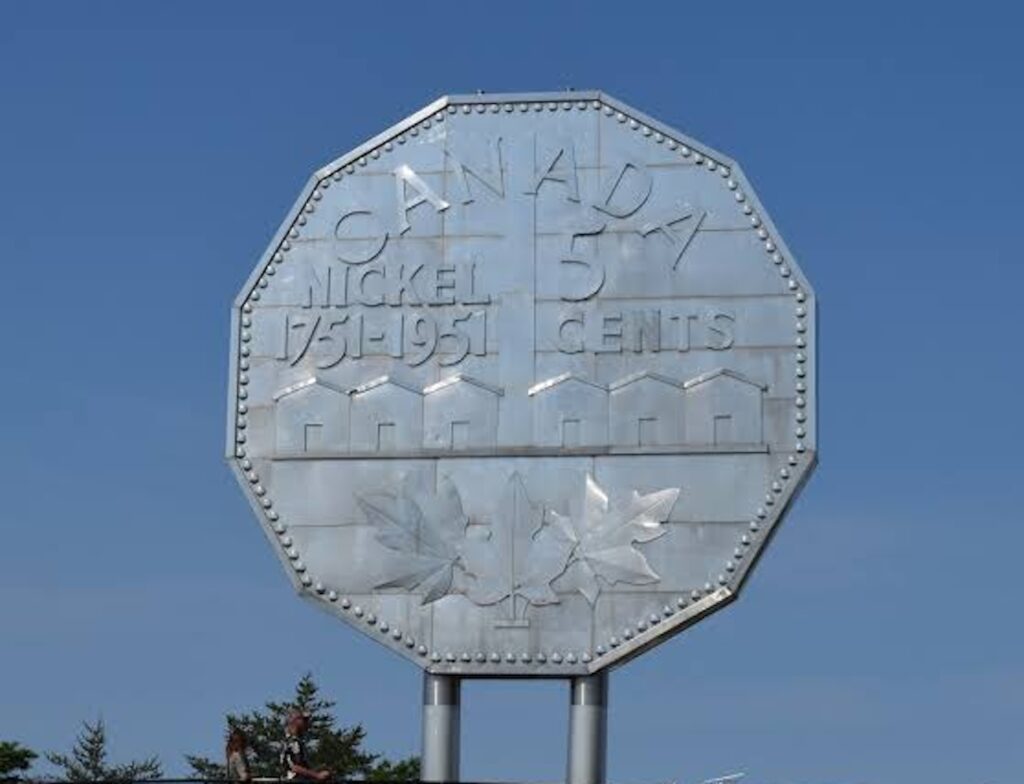
Every visitor to Sudbury eventually asks the same two questions while standing in front of the giant coin: “Is that thing actually made of nickel?” and “How much is the Big Nickel worth?”
Here’s the straight answer from someone who has walked under it more times than I can count.
What Exactly Is the Big Nickel?

The Big Nickel is a 9-metre (30-foot) replica of a 1951 Canadian five-cent coin. It sits on a rock base at Dynamic Earth on Big Nickel Road in Greater Sudbury. Add the base and the whole structure reaches about 12.8 metres. It is roughly two feet thick and weighs around 13,000 kilograms — about the same as a city bus.
It is officially recognized as the world’s largest coin. For scale, it is approximately 64.6 million times bigger than a regular Canadian nickel.
You can walk right under it. That is half the fun. If you’re planning a wider trip around the city, check out our full guide to what to see in Sudbury in 2026.
Is the Big Nickel Made of Nickel?

No.
It is made of stainless steel sheets fastened to a steel frame and joined with silver solder. Stainless steel contains some nickel (that is part of what makes it rust-resistant), but the monument is not solid nickel or even mostly nickel.
Building it from pure nickel in 1964 would have been insanely expensive. Stainless steel was the practical choice for Sudbury’s weather — freezing winters, wet springs, and everything in between. The surface still looks sharp decades later because of that decision.
The real 1951 five-cent coin that inspired it was nearly pure nickel. Today’s circulating Canadian nickels are mostly steel with a thin nickel plating. The Big Nickel sits somewhere in the middle: a steel structure that happens to contain nickel, built to honour a city that once produced a huge share of the world’s supply.
How Much Is the Big Nickel Worth?
This is the question that gets people excited, and the honest answer is less exciting than the mythology.
Original construction cost (1964): approximately $35,000 CAD. In today’s dollars that is roughly $350,000.
Ted Szilva, the local firefighter who pushed the project through, raised most of the money by selling miniature commemorative medallions. The city had rejected his idea, so he built it himself just outside the old city limits.
In 1980 he sold the attraction and the surrounding property to the Regional Municipality of Sudbury for around $525,000–$550,000. That was the last time it changed hands as a private asset.
Today the Big Nickel is not for sale. It is a public landmark managed as part of Dynamic Earth / Science North. Scrap value of the stainless steel would be a fraction of its cultural and tourism value. The real worth is in the tens of thousands of visitors who stop every year for photos, the kids who walk underneath it, and the simple fact that it still works as a symbol of Sudbury’s mining roots more than 60 years later.
So if someone tells you the Big Nickel is “worth millions,” they are talking about its place in the community, not a realistic sale price.
Quick Facts Worth Knowing
- Height of the coin itself: 9 metres (30 feet)
- Thickness: 0.61 metres (2 feet)
- Weight: ≈ 13,000 kg
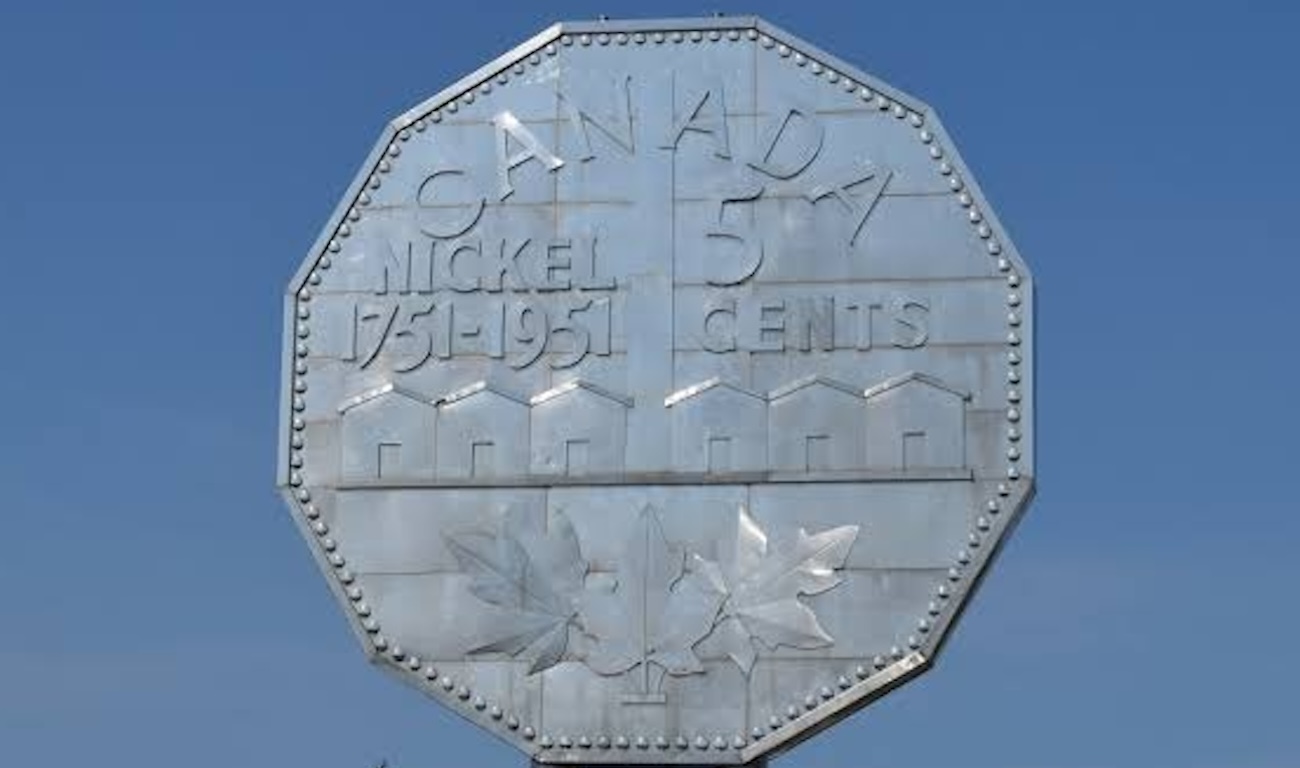
- Design: 1951 Canadian nickel — King George VI on one side, a stylized nickel refinery on the other (not the Superstack — that came later)
- Shape: 12-sided, just like the original 1951 coin
- You can walk under the base
- Viewing the coin is free year-round
The Story Behind It (Ted Szilva’s Stubborn Idea)
In 1963 a young Sudbury firefighter named Ted Szilva proposed a giant nickel, a model mine, and a science centre as the city’s Centennial project. The committee turned him down. He bought land anyway, leased more from Inco for road access, and raised the money himself.
Local artist and sign-maker Bruno Cavallo designed and fabricated the stainless steel panels. The Big Nickel opened on July 22, 1964. For a while it was the centrepiece of a small numismatic park that also had oversized versions of a penny, a Lincoln cent, a Kennedy half-dollar, and a $20 gold piece. Those other coins were dismantled in 1984. The Big Nickel stayed.
It was temporarily moved for refurbishing in the early 2000s and then reinstalled at Dynamic Earth, where it still stands.
Visiting the Big Nickel in 2026

The coin itself is free to see any time. You do not need a ticket just to take photos or walk under it. That makes it one of the easiest free things to do with kids in Ontario.
Dynamic Earth (the science centre next to it) does charge admission if you want the underground mine tour, exhibits, and indoor experiences. Hours vary by season — check the Science North website before you go. Parking is available on site.
Practical tips:
- Best light for photos is usually morning or late afternoon.
- The base is barrier-free.
- There is a short trail (Big Nickel Trail) that heads down the hill if you want a short walk.
- Combine it with Science North if you have a full day, or treat it as a quick roadside stop if you are just passing through.
It is one of the easiest, most reliable photo stops in Northern Ontario. Families, road-trippers, and people who just want something different all stop here. If you’re continuing west, our Sudbury to Thunder Bay drive guide covers the full route and other worthwhile stops along the way.
For more unusual stops across the province, take a look at our list of Ontario hidden gems for 2026.
FAQ
Is the Big Nickel free to visit?
Yes. Looking at and walking under the coin is free. Dynamic Earth admission is separate.
Can you go inside the Big Nickel?
No. It is a solid structure (steel frame with stainless steel skin).
How much did it cost to build?
About $35,000 in 1964 money.
Is it really the world’s largest coin?
Yes. It holds the record for the largest replica coin.
Why does it look different from today’s nickels?
It is modelled on the 1951 12-sided design, not the modern round beaver nickel.
Look, the Big Nickel was never meant to be some high-value collectible or pure-metal marvel. It was one guy’s stubborn idea that somehow stuck. Sixty years on, it still does the job: it makes you pull over, look up, and remember that Sudbury’s history is written in hard metal and harder work.
If you’re driving through Northern Ontario, just stop. Walk under it, snap the photo, and keep going. Five minutes well spent.