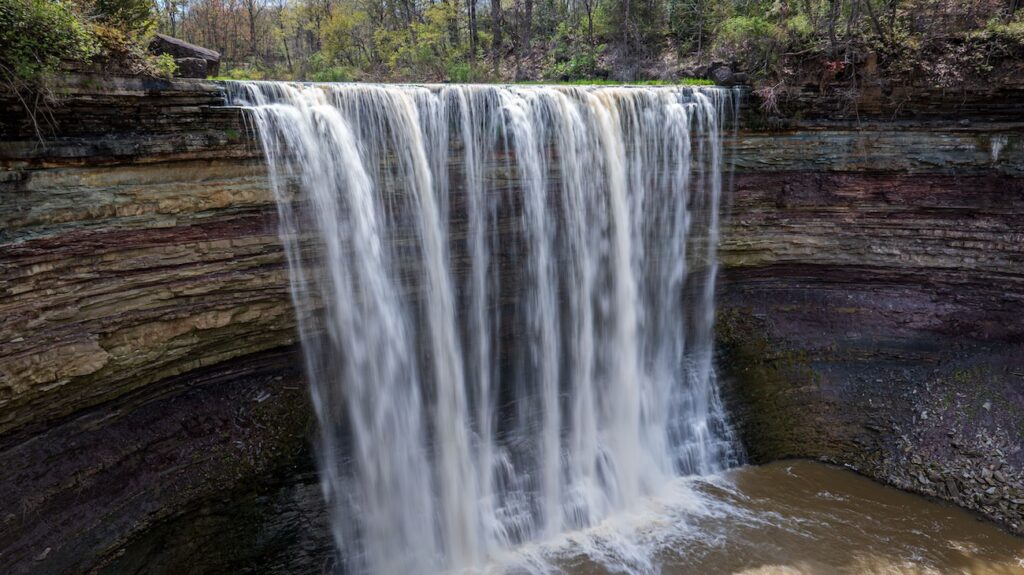
Lower Decew Falls doesn’t get the same attention as its bigger sibling just upstream. That’s partly because it’s smaller, partly because getting a clear look at Lower Decew Falls takes more effort than most people expect, and partly because access rules have tightened in recent years.
If you’re planning a stop near St. Catharines or Thorold in 2026, here’s the practical, no-hype version of what you’ll find at Lower Decew Falls—one of those quieter Ontario hidden gems that rewards realistic expectations.
Upper vs Lower Decew Falls – What’s the Actual Difference

Upper DeCew Falls is the main event most people come for. It drops about 22 metres (roughly 72 feet) in a classic ribbon plunge into a bowl-shaped rock amphitheatre. The restored Morningstar Mill sits right at the brink. From the established lookouts along the Bruce Trail and the mill area, you get a solid view of the full drop and the curved gorge walls.
Lower Decew Falls sits just downstream. Lower Decew Falls is shorter—around 8 metres—and takes the form of a steep, stepped cascade (sometimes called a washboard or classical cascade). The water tumbles over a series of ledges rather than free-falling in one clean drop. In good flow Lower Decew Falls looks attractive and layered; in drier periods it can thin out noticeably.
Water levels here are regulated. Beaverdams Creek has been managed for decades for municipal supply and hydroelectric use, so the falls can range from a strong curtain after rain or spring melt to a thin trickle in dry spells. Spring is usually the most reliable time for volume at both the upper drop and Lower Decew Falls.
There’s also a man-made feature nearby known as Tunnel Falls, created by the old generating station tunnels cut through the escarpment layers.
Current Access Reality (2026)

This is the part most older guides get wrong or leave vague when covering Lower Decew Falls.
Morningstar Mill completed a major $2-million restoration and reopened to the public in late July 2026. It is typically open Tuesday, Thursday, Saturday, and Sunday. The Bruce Trail access along the rim stayed available during the construction period. Free parking is available in the mill lot at 2714 Decew Road.
The big caveat for anyone seeking Lower Decew Falls: access into the Decew Gorge itself has been restricted or prohibited in recent years. Repeated misuse, accidents, and rope rescues (especially at the upper falls) led to closures of unofficial side trails and bottom routes. Waterfalls of Ontario and multiple recent trail reports note that bottom access is not currently permitted and that the site is coded as more difficult/challenging for a reason.
What this means in practice for Lower Decew Falls:
- You can reliably see the upper falls from the mill area and official Bruce Trail lookouts.
- Views of Lower Decew Falls from the legal rim trail are often partial—filtered through trees and vegetation, especially in full leaf.
- Unofficial descents using ropes, roots, or steep scrambles are strongly discouraged. They are dangerous, have caused injuries, and in some sections cross private property.
Stay on the marked trail. It’s the only way to visit Lower Decew Falls responsibly and avoid contributing to further restrictions.
How to Visit – Practical Trail & Parking Tips

Parking: Free lot at Morningstar Mill (2714 Decew Road, St. Catharines / Thorold boundary). Arrive earlier on weekends—the lot fills.
Getting there:
- From Niagara Falls: roughly 20–30 minutes west.
- From Toronto: about 90–100 minutes via QEW and Highway 406, then local roads to Decew Road.
- From downtown St. Catharines: short drive south/west.

Trail options: The popular Decew Falls Loop is short and relatively easy—around 1.4 to 2.25 km depending on the exact route, with modest elevation. It uses sections of the Bruce Trail and sometimes the Laura Secord Legacy Trail. Expect packed earth, some roots and rocks, and potentially muddy or icy sections depending on the season. This is the practical way most people experience Lower Decew Falls without risking the gorge.
Footwear with decent grip is non-negotiable. Ticks are common in the Niagara Escarpment woods—check yourself and dogs thoroughly after. Cell coverage can be spotty in the gorge area.
Facilities are limited. When the mill is open you may have access to washrooms and the option of a free (donation-appreciated) tour of the working water-powered mill and the restored miller’s house.
Best Time to Visit & What to Expect Seasonally
- Spring (especially after rain or snowmelt): Best water volume and sound. Lower Decew Falls looks more impressive with stronger flow.
- Fall: Excellent colour along the escarpment trails. Crowds thin out compared with peak summer.
- Summer: Convenient for combining with the mill, but flow can be lower and vegetation thicker, reducing Lower Decew Falls visibility from the rim.
- Winter: The upper falls can freeze into striking ice formations. Rim views only—ice and steep ground make any descent extremely hazardous.
Early morning or weekday visits give you quieter trails and better parking odds when checking out Lower Decew Falls.
Safety & Responsible Visiting
The gorge walls are steep. The ground can be slippery when wet. Falling rock is a real risk. Private property exists along parts of the creek downstream—respect it.
If a trail looks unofficial or has a rope hanging from a tree, treat that as a hard stop. Multiple sources and local experience confirm that rope rescues have been needed here. The responsible choice for seeing Lower Decew Falls is the marked Bruce Trail viewpoints.
Leave no trace. Pack out what you bring in. The area has already seen enough damage and misuse that access has been tightened.
Combining Your Visit
Once you’ve seen the falls from the rim and (if open) toured Morningstar Mill, you can easily extend the day:
- Continue on the Bruce Trail toward Rockway Falls or other nearby escarpment sections.
- Head into Short Hills Provincial Park for more trails.
- Pair it with other lower-key Niagara Region nature spots, including a stop at the Niagara Glen Nature Centre if you’re exploring more of the escarpment.
- Look at other free things to do with kids in Ontario if you’re travelling as a family and want low-cost outdoor options nearby.
This is not a replacement for the big commercial Niagara Falls experience. It’s a quieter, more local escarpment stop with history and nature in a compact package—provided you go in with realistic expectations about Lower Decew Falls.
FAQ
Is Lower Decew Falls open / accessible in 2026?
The rim trail and Morningstar Mill area are accessible. Direct bottom access to Lower Decew Falls via the gorge remains restricted or prohibited. Stick to official trails.
Can you hike to the bottom of Lower Decew Falls?
Not legally or safely on maintained routes right now. Unofficial paths exist but carry real risk and are not recommended for reaching Lower Decew Falls.
Where is the parking?
Free parking at the Morningstar Mill lot, 2714 Decew Road—the starting point for viewing Lower Decew Falls from the rim.
How long is the Decew Falls trail?
The common loop is roughly 1.4–2.25 km and takes most people 30–60 minutes at an easy pace, plus time at the viewpoints and mill while looking for Lower Decew Falls.
Is it family-friendly / dog-friendly?
The rim trail and mill area are suitable for families with reasonable fitness and dogs on leash. The steep unofficial descents to Lower Decew Falls are not appropriate for kids or most dogs. For more family outdoor ideas, see our guide to free things to do with kids in Ontario.
What’s the difference between Upper and Lower Decew Falls?
Upper is the taller (≈22 m) dramatic plunge into an amphitheatre. Lower Decew Falls is the shorter (≈8 m) stepped cascade downstream. The upper is far easier to view properly from legal lookouts than Lower Decew Falls.
Lower Decew Falls rewards people who value a short, honest escarpment walk and a piece of local industrial heritage more than Instagram-perfect bottom-of-the-falls shots. Manage the expectations around Lower Decew Falls, stay on the trail, and you’ll leave with a solid little Ontario waterfall experience that still feels relatively uncrowded.
If you’re building a 2026 Niagara-region itinerary around quieter waterfalls and heritage sites, Lower Decew Falls is a reliable stop—just keep the safety notes front of mind. For more under-the-radar spots across the province, check our roundup of Ontario hidden gems for 2026.